Crack Width Calculation Ec2
Rafal, I've contacted authors of the book example and they both agree there's an error in their example (regarding cracks width calculation). They are thankful for good remarks.:) They think that this 'c' variable in EC2 (7.11) shouldn't be called 'c' because according to EC2 4.4.1.1. (1) - 'c' stands for ' The concrete cover is the distance between the surface of the reinforcement closest to the nearest concrete surface (including links and stirrups and surface reinforcement where relevant) and the nearest concrete surface. ', but that's completly another thing to discuss. After all, I am glad that error is in their example, not Robot.:D Still waiting for the second part of the answer (regarding calculation of deflections). The RSA does not take into account the effect of shrinkage. In the attached case, the effect of shrinkage is: 9.43 * 10 ^ -6/4.183 ^ 5 = 0,225 ->22% If from book result 27.9 we subtract (22%* 27.9 =) 6.28 we get 21.6mm Minor differences: when we detect that the concrete is 'typical' (ie, as in the EC2 table), the Young modulus is taken from the table and not calculated.
R or RS) 2 CALCULATIONS modulus of elasticity of concrete = 22[(fck+8)/10]0.2 14 N 2.Project Spreadsheets to EC2 Client Advisory Group Location Grid line 2 FLEXURAL CRACK WIDTH CALCULATION to BS EN 1992-1: 2004 Originated from TCC14. Calculation is based on section 7.3.45. The following figure reproduced from EC2 explains the preceding. • Crack width for prestressed concrete.
The differences in the position of the rebar can change the moment of inertia. Stylus Rmx Sage Converter Lion Brand on this page. However, this would explain the differences of a few rather than 10% When you set “Display diagrams for all combinations”, we get instead of 21.6mm 20.9mm ->0.7mm. (Difference near 3% already may be due to other differences I mentioned earlier) The mistake is located in taking the final calculation of the elastic deflection as of the envelope of all combinations and not as an envelope of QPR combinations. Need to be corrected in software. Hello, gentleman, Sorry for butting in, but I have a question regarding crack calculation. I have to design a septic tank, and I would like to calculate / check width of crack with DISREGARD of effect of concrete in tensile zone (I want to know the additional amount of reinforcement, when I calculate a panel as if it already is cracked – I hope I am explaining it understandably).
To disregard the effect of concrete in tensile zone, I have to delete (or set value as 0 MPa) a tensile strength of concrete, but in “Custom material properties” tab there is no such value to change. So, maybe there is a different way to define tensile strength of concrete? Thank you in advance, Best regards, Paul.
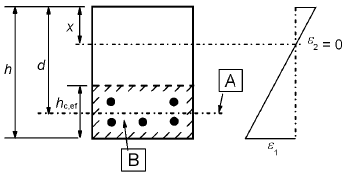
• Where the bonded reinforcenlent is fixed at reasonably close centres within the tension zone (spacing ≤ 5( c + Φ/2), cf. Figure 7.2), the maximum crack spacing s r,max may be calculated as follows: s r,max = k 3 c + k 1 k 2 k 4 Φ / ρ p,eff (7.11) where: Φ is the bar diameter. Where a mixture of bar diameters is used in a section, an equivalent diameter,, should be used. C is ρ p,eff see the difference of the mean strains above k 1 is a coefficient which takes account of the bond properties of the bonded reinforcement: k 1 = 0,8 for high bond bars, k 1 = 1,6 for bars with an effectively plain surface (e.g. Prestressing tendons).
K 2 is a coefficient which takes account of the distribution of strain: k 2 = 0,5 for bending, k 2 = 1,0 for pure tension. 9 Pin Serial Cable Wire Colors. Intermediate values of k 2 should be used for cases of eccentric tension or for local areas: k 2 = ( ε 1 + ε 2)/(2 ε 1) (7.13) where ε 1 is the greater and ε 2 is the lesser tensile strain at the boundaries of the section considered, assessed on the basis of a cracked section.
Lineage 1 Bot Program For Clash. K 3 is a Nationally Determined Parameter, see k 4 is a Nationally Determined Parameter, see. • Where the spacing of the bonded reinforcement exceeds 5( c + Φ/2) (cf. Figure 7.2), or where there is no bonded reinforcement within the tension zone, the maximum crack spacing s r,max may be calculated as follows: s r,max = 1,3( h - x) (7.14) where: h is the overall depth of the section (see ) x is the neutral axis depth of the section (see ).
This application calculates the crack width w k from your inputs. Intermediate results will also be given. First, change the following option if necessary.